Warehouse Scale Selection: A Practical System Guide
Choose a warehouse scale by workflow, load format, capacity, environment, data needs, calibration, and service requirements with this practical guide.

A warehouse scale should be selected as part of the material-handling process, not as a standalone platform with an adequate capacity label. Start with what is weighed, where the weight is needed, how the load arrives, what decision follows, and how data must move. Those answers determine whether the right system is a floor, pallet, forklift, bench, counting, or other industrial scale—and what installation, indicator, software, protection, and service support it needs.
Key takeaways
- Map the workflow before selecting a scale type.
- Specify both the heaviest possible gross load and the useful resolution at normal loads.
- Account for pallet size, load position, traffic, impacts, washdown, dust, temperature, and floor condition.
- Decide whether the weight is for internal control, shipping, inventory, safety, or a regulated transaction.
- Treat the indicator, data connection, installation, calibration, and service access as parts of one system.
- Validate the complete installed scale with representative loads before operational release.
Match the scale to the warehouse task
The best weighing point is usually where an operator can capture a reliable result without creating extra travel, queueing, or manual transcription. Observe the real route from receiving through storage, picking, packing, and shipping. Note whether loads arrive on pallets, in totes, as cartons, or as loose parts, and whether they are stable enough for static weighing.
| Warehouse task | Typical scale approach | Main selection question |
|---|---|---|
| Receiving or shipping full pallets | Floor platform, low-profile deck, or pallet scale | Can every pallet enter, settle, and leave safely? |
| Weighing during movement | Forklift-mounted system | Is speed more important than static-scale performance? |
| Packing cartons or parts | Bench or table scale | Does the platform and resolution fit normal package sizes? |
| Inventory by quantity | Counting scale or connected bench scale | Are unit weights consistent enough for the process? |
| Capturing weights into WMS or shipping software | Scale plus compatible terminal/interface | How will records be identified, validated, and transferred? |
A scale that looks efficient in a catalog can become a bottleneck if operators must reposition loads, walk to an indicator, or key results into another system. Include operators, safety personnel, quality staff, IT, and maintenance in the workflow review.
Floor, pallet, and forklift scales are not interchangeable
These adjacent products serve different search and buying intents. A floor scale is a stationary deck suited to loads that can be placed, allowed to settle, and removed. It can provide a controlled weighing position but needs floor space, safe approaches, and protection from vehicle impact. See the dedicated floor scale selection guide for deck, ramp, pit, and environment choices.
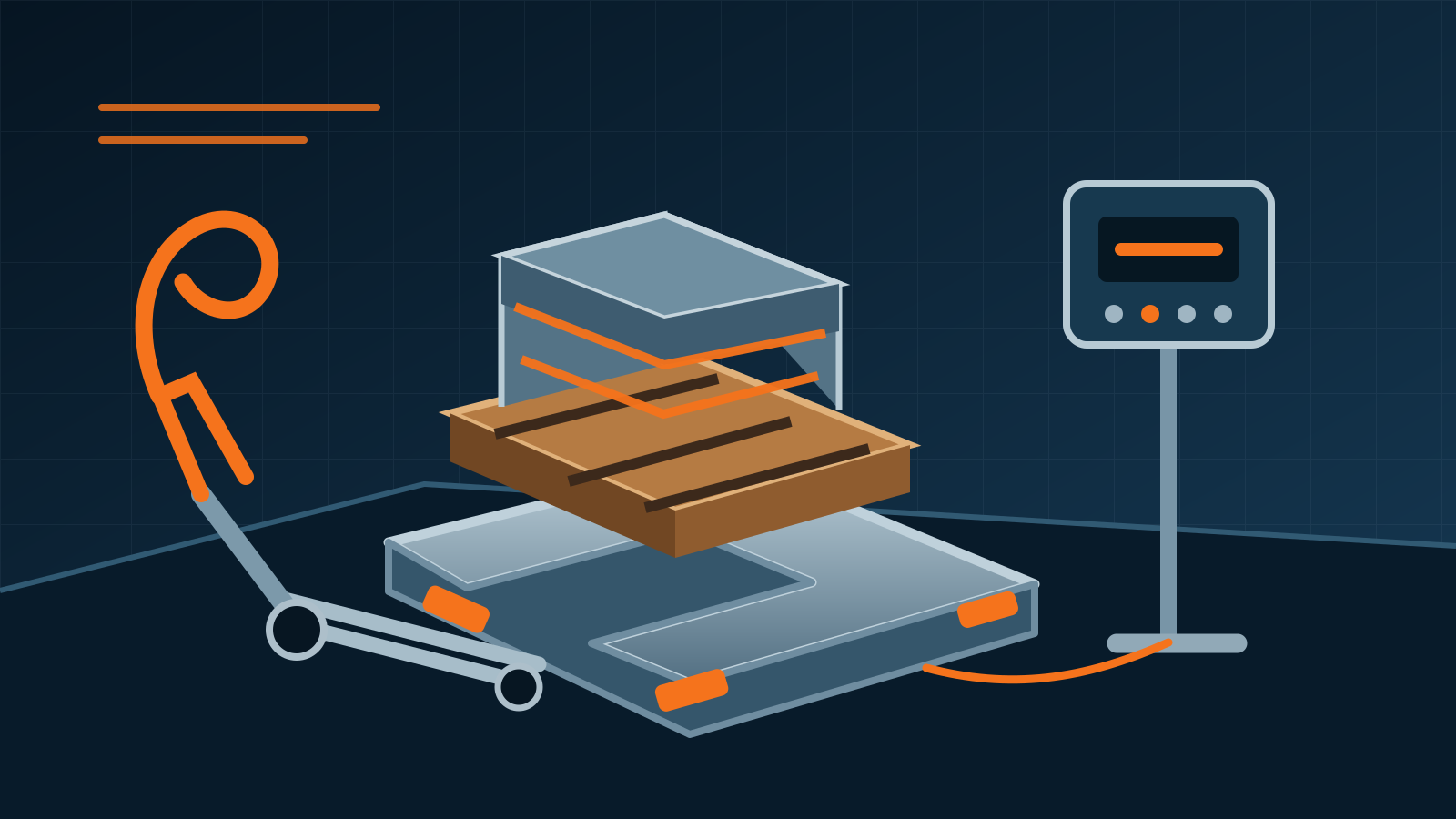
A pallet scale is a stationary arrangement shaped or accessed for palletized goods. It may reduce the handling needed to position a pallet, but pallet geometry, load stability, and the handling device still govern suitability. The term describes the use case more than one universal construction, so compare actual platform and access details in our pallet scale guide.
A forklift scale measures while the load is on the truck. It can remove a separate weighing stop, but truck condition, surface level, lift technique, load position, and operator practice affect results. Use our dedicated forklift scale guide for that equipment-specific decision. This warehouse-scale guide instead focuses on selecting the overall weighing system and its place in operations.
Build a requirement from the load
Document the smallest routine load, typical load, maximum expected gross load, and credible abnormal load. Gross load includes pallets, bins, fixtures, packaging, and anything else supported by the scale. Capacity needs margin for real operation, but simply choosing the highest available capacity may produce a displayed increment or performance that is poorly matched to lighter routine loads.
Also record:
- load dimensions, footprint, center-of-gravity variation, and overhang;
- whether goods can shift, leak, roll, or create side contact;
- pallet and container tare variation;
- how a pallet jack, forklift, conveyor, or person approaches the scale;
- required stabilization time and throughput;
- the operational tolerance that the weighing result must support.
Ask suppliers to explain capacity, readability, repeatability, and stated accuracy separately. A fine display increment does not by itself prove that the installed system can meet the process tolerance.
Specify the installation environment
Warehouse conditions are often harsher than an indoor label suggests. Forklift impacts, shock loading, vibration, dust, condensation, temperature changes, washdown, corrosive products, uneven slabs, and standing water can all matter. The platform, load cells, junction equipment, indicator, cables, connectors, ramps, bump protection, and foundation must suit the same environment.
Plan traffic around the weighing point. A ramp changes the footprint and may create a collision or pedestrian interface. A pit installation can keep the deck flush but introduces drainage, cleaning, access, and structural requirements. Cables need protected routes that do not become trip hazards or run where wheels and pallets can crush them.
The structure must support the system as designed without rocking or unintended contact. Installation should follow manufacturer drawings and site engineering requirements rather than improvised shimming or restraint.
Decide what the weight must do
An internal check for freight planning is different from a weight used to price goods. If the result affects a regulated commercial transaction, confirm legal-for-trade requirements in the relevant jurisdiction before purchase. Approval of an individual component does not necessarily approve every assembled configuration.
For quality or process control, define the permitted error and the consequence of a bad decision. Then determine what calibration, verification, routine checks, records, and access controls are required. Confirmation against requirements is distinct from adjustment, so define both activities in the service plan.
Data requirements deserve the same attention. Specify whether the system must print a ticket, send stable weights to a warehouse management system, associate readings with an order or barcode, prevent duplicate captures, retain an audit trail, or work during a network outage. Confirm protocol and software compatibility through documented interfaces and an acceptance test; “connectable” is not a complete integration specification.
Warehouse scale buying checklist
- Map the actual receiving, storage, picking, packing, or shipping workflow.
- Record minimum routine, typical, maximum gross, and credible abnormal loads.
- Confirm platform dimensions, pallet access, load stability, and safe traffic flow.
- Define the operational tolerance and required displayed resolution.
- Identify impact, vibration, moisture, dust, temperature, corrosion, and cleaning exposure.
- Confirm indicator location, visibility, controls, power, and cable protection.
- Document printing, barcode, WMS, network, user-access, and offline requirements.
- Determine legal-for-trade, quality-system, or other verification obligations.
- Include installation, test loads, operator training, calibration, and service response.
- Run an acceptance test with representative loads and end-to-end data capture.
Commissioning and lifecycle support
Before release, inspect the load path and approaches, check zero and repeatability, evaluate off-center response where applicable, and test across the intended working range with suitable references. Confirm tare, units, filtering, printing, integrations, alarms, and behavior after power or network interruption. Train operators to center loads, avoid impacts, recognize unstable readings, and report damage.
Calibration frequency is not universal. Set an initial interval using manufacturer guidance, application risk, usage, environment, jurisdiction, and quality requirements, then adjust it from documented history. Routine checks with controlled references can reveal a change between calibrations. Include cleaning, inspection, records, and escalation rules without encouraging unauthorized adjustment.
This article is general guidance. Final selection, foundation and traffic design, regulated-use decisions, installation, calibration, and verification should involve qualified providers and the relevant authorities where applicable.
Frequently asked questions
What type of scale is best for a warehouse?
The best type depends on where weighing fits in the workflow. Floor or pallet scales suit stationary loads, forklift scales weigh during handling, bench scales suit cartons and parts, and counting systems support inventory tasks. Select from the process requirements rather than from capacity alone.
How much capacity should a warehouse scale have?
Capacity should exceed the heaviest gross load that can reasonably reach the scale, including pallet, container, fixture, and any applied preload. It also must provide useful resolution at normal working loads. A qualified supplier can help balance capacity, resolution, and overload risk.
Does a warehouse scale need to be legal for trade?
It may if its result determines price, charge, or another regulated commercial quantity. Requirements depend on application and jurisdiction. Confirm them with the relevant legal-metrology authority and choose an approved, verified system where required.
How often should a warehouse scale be calibrated?
There is no universal interval. Set it from use, environment, risk, manufacturer guidance, service history, and applicable quality or legal requirements. Routine checks between calibrations can identify damage or drift earlier.
Related guides
Pallet Scale Guide: Types, Uses and Selection
Learn what a pallet scale is, compare static platforms, pallet jack scales and forklift scales, and choose equipment for receiving, shipping and inventory.

Forklift Scales: How They Work, Accuracy and Buying Criteria
How forklift scales weigh loads on the forks, what affects their accuracy, the main types, and the criteria to check before buying one for a warehouse.
Bagging Scale: Selection and Integration Guide
Learn how a bagging scale weighs and fills bags, how major system types differ, and what to specify for safe, reliable packaging-line integration needs.