Pallet Scale Guide: Types, Uses and Selection
Learn what a pallet scale is, compare static platforms, pallet jack scales and forklift scales, and choose equipment for receiving, shipping and inventory.
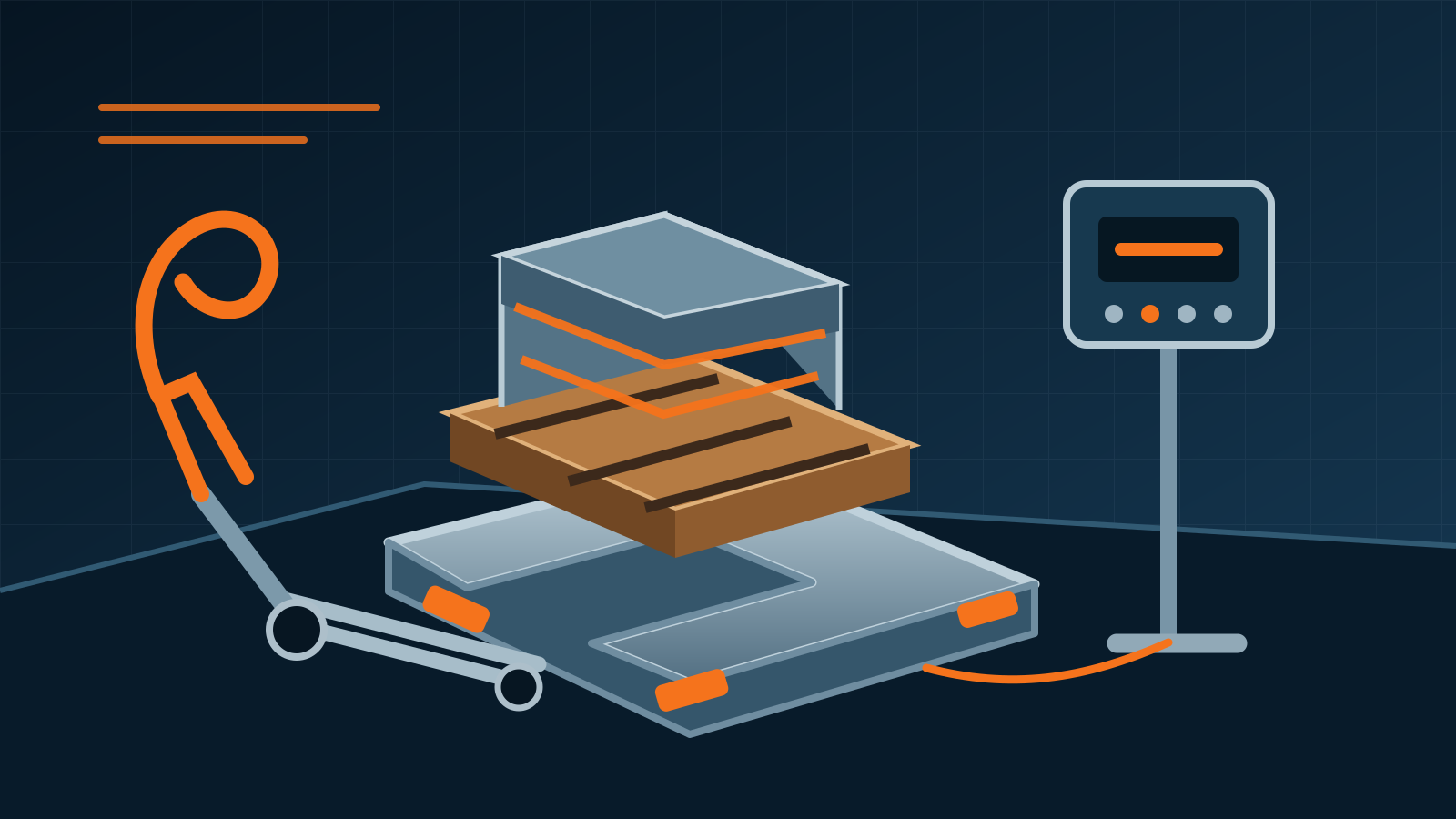
A pallet scale weighs goods while they remain on a pallet, reducing manual handling and helping warehouses capture receiving, production, inventory or shipping data. The right configuration depends on the material-handling workflow: a static platform offers a controlled weighing station, a pallet jack scale weighs during low-level transport, and a forklift scale captures weight on a powered truck. These are distinct solutions, not interchangeable names.
Key takeaways
- “Pallet scale” describes the application; the equipment may be a floor platform, U-frame, weigh beams, pallet jack scale or forklift scale.
- Static scales favor a stable, repeatable weighing location; mobile systems favor fewer handling steps.
- Confirm the total supported load, pallet footprint, entry direction and wheel or fork geometry.
- Forklift and pallet jack scales differ in vehicle type, sensing method, installation and operator workflow.
- Data, tare and identification requirements should be defined before choosing the hardware.
- Commercial or regulated use may require an approved instrument, controlled procedure and authorized service.
Pallet scale options compared
| Configuration | How the pallet is weighed | Best suited to | Main trade-off |
|---|---|---|---|
| Floor platform | Pallet is deposited or rolled onto a deck | Dedicated receiving or shipping station | Requires floor space and loading access |
| U-shaped pallet scale | Pallet jack enters the open center and lowers the pallet onto the frame | Frequent standard-pallet weighing | Pallet geometry and entry orientation must fit |
| Weigh beams | Pallet or container rests across two separate beams | Varied footprints and occasional setups | Alignment, cable protection and controlled support matter |
| Pallet jack scale | Load is lifted on instrumented pallet-jack forks | Mobile weighing during manual handling | Floor condition and lifting technique affect results |
| Forklift scale | Powered truck weighs through forks, carriage, hydraulic system or factory integration | High-throughput powered handling | Truck behavior, attachment geometry and service integration matter |
A floor scale can weigh much more than pallets and is often the most versatile fixed station. U-shaped frames and weigh beams are more application-specific ways to avoid ramps or accommodate particular load shapes.
Static pallet scales
A static pallet weighing scale separates weighing from travel. The operator places the pallet on the platform, withdraws the forklift or releases the pallet jack, waits for a stable reading and records the result. Removing handling equipment from the active load makes it easier to define exactly what is being weighed.
Above-floor platforms may use ramps for pallet-jack access. The ramp, deck and surrounding approach must support the actual traffic safely. A pit-mounted platform can provide a flush route but adds civil work, drainage, cleaning and service-access requirements. Forklift placement avoids rolling across a ramp, although operators need enough room to deposit the pallet without striking the deck.
U-shaped scales let a pallet jack enter an open center. The load is lowered so the pallet rests on the weighing frame, then the truck can be removed. This can speed routine weighing where pallet dimensions and orientation are consistent. It is less flexible when pallets have unusual runner layouts, overhang or damaged boards.
Weigh beams provide two narrow supporting structures that can be spaced for long loads or containers. They should be aligned, supported on a suitable surface and used with loads that bridge them safely. Their apparent portability does not remove the need for cable protection, consistent geometry and setup checks.
Pallet jack scale: mobile weighing at floor level
A pallet jack scale integrates load sensing into the forks or chassis of a pallet truck. The operator enters a pallet, raises it to the prescribed weighing position and obtains the reading from an onboard indicator. Hand pallet trucks and powered walkie equipment may both be available with weighing, but compatibility and operating details vary.
This approach removes a separate scale stop and can be useful for receiving checks, inventory movement or staging. It also makes the measurement dependent on mobile-equipment condition and use. Uneven floors, debris under wheels, a partially engaged pallet, contact with another object or an unstable load can reduce repeatability. Operators should follow the manufacturer’s specified fork height, motion and settling procedure.
Evaluate ergonomics as well as weighing features. Indicator visibility, controls, battery charging, total truck weight, turning space and maintenance access affect daily adoption. The pallet truck must remain suitable for moving the intended loads; weighing capability does not change safe material-handling limits.
Forklift scale: weighing on a powered truck
A forklift scale is installed on or integrated with a powered industrial truck. Depending on design, it may infer load from hydraulic pressure, use instrumented forks, replace or add to the carriage, or form part of the original truck system. It captures weight higher in the handling flow and can support operations where pallets rarely move by pallet jack.
That integration creates considerations not present on a static platform. Lift height, mast angle, attachment position, load center, acceleration and floor slope may influence the reading. Added equipment can affect visibility, fork geometry, carriage dimensions or truck capacity information and must be reviewed by qualified parties. For a fuller treatment of sensing methods and selection, see the dedicated forklift scale guide.
A pallet jack scale is therefore not simply a smaller forklift scale. It is built around low-level pallet-truck handling, while a forklift system is tied to a powered truck, mast and carriage. Choose between them based on the fleet and route that already move the pallet.
Capacity, pallet fit and tare
Document the maximum gross load, including product, pallet, wrapping, bins and any supported handling equipment. Do not size only for the typical shipment. Review concentrated loading from runners, feet or damaged pallets, and confirm how off-center loads are handled by the selected design.
The active area must support the pallet correctly. Record common pallet styles, dimensions, entry openings, overhang and nonstandard containers. For U-frames, confirm the pallet contacts the intended rails. For beams, define spacing and bridging. For mobile forks, confirm length, width, thickness and pallet access.
Tare removes the known weight of a pallet or container from the gross reading to estimate net product weight. Decide whether operators enter a stored tare, weigh an empty pallet, scan a pallet type or capture gross-only data. Mixed or damaged pallets can undermine a generic tare assumption, so the method should match the required quality of the result.
Workflow and data requirements
Map the transaction before requesting quotations:
- Identify the pallet, product, order or supplier.
- Capture tare by the approved method.
- Position and stabilize the load.
- Record gross and net values with operator or time information as needed.
- Transfer the result to a label, ticket, warehouse system or quality record.
- Route exceptions, overloads and unstable readings for review.
Connectivity may include printers, scanners, wired interfaces or wireless transmission. Confirm how records are validated, corrected, stored and protected during network loss. A display value alone may not satisfy traceability or shipping needs.
Pallet scale selection checklist
- Handling route identifies where weighing adds the least risk and delay
- Static platform, U-frame, beams, pallet jack or forklift approach chosen
- Maximum gross load and concentrated loading reviewed
- Every pallet and container footprint fits the support geometry
- Floor condition, ramps, clearance and traffic controls assessed
- Tare, labeling, scanning and system integration defined
- Power, charging, cables and environmental exposure addressed
- Operators can position loads without impact or unsafe reach
- Calibration, maintenance and local service responsibilities assigned
- Approval requirements confirmed for consequential weight data
No single pallet scale is best for every warehouse. Select the weighing point that matches the real movement of goods, then specify the mechanics, measurement performance and information flow as one system.
Frequently asked questions
What is a pallet scale?
A pallet scale is weighing equipment configured to support a loaded pallet. The term can refer to a floor platform, U-shaped or beam system, pallet jack scale or forklift-mounted scale, so the loading method should be specified when comparing products.
Is a pallet jack scale the same as a pallet scale?
A pallet jack scale is one type of pallet scale. Its load cells are built into the pallet truck forks, allowing the operator to lift, move and weigh a pallet. A static pallet platform remains on the floor and generally provides a more controlled weighing position.
What is the difference between a forklift scale and a pallet jack scale?
A forklift scale weighs on a powered lift truck using hydraulic sensing, load-cell forks, a weighing carriage or an integrated system. A pallet jack scale uses a hand or powered pallet truck with weighing built into its low forks. They have different vehicle compatibility, operating procedures and service needs.
Can a pallet scale be used for shipping weights?
It can support shipping records when its capacity, performance, calibration, procedure and approval suit the purpose. If weight determines price, freight charges or another regulated transaction, confirm legal and contractual requirements with the relevant authority and carrier rather than assuming any pallet scale is acceptable.
Related guides

Warehouse Scale Selection: A Practical System Guide
Choose a warehouse scale by workflow, load format, capacity, environment, data needs, calibration, and service requirements with this practical guide.

Forklift Scales: How They Work, Accuracy and Buying Criteria
How forklift scales weigh loads on the forks, what affects their accuracy, the main types, and the criteria to check before buying one for a warehouse.
Bagging Scale: Selection and Integration Guide
Learn how a bagging scale weighs and fills bags, how major system types differ, and what to specify for safe, reliable packaging-line integration needs.